


Von der kostenlosen Demo über die 40 Übungsfragen bis zum 365-tägigen Update-Service: ITZert begleitet Ihre gesamte Vorbereitung auf die CIPS Global Commercial Strategy Prüfung aus einer Hand. Starten Sie jetzt und gehen Sie Ihre L6M2 Zertifizierung im Jahr 2026 strukturiert an.
CIPS L6M2 Prüfungsübersicht:
| Zertifizierungsanbieter: | CIPS (Chartered Institute of Procurement & Supply) |
|---|---|
| Prüfungsname: | Globale Handelsstrategie |
| Prüfungsnummer: | L6M2 |
| Gültigkeitsdauer des Zertifikats: | 5 Jahre für CIPS-Qualifikationen (unter Vorbehalt der CIPS-Fortschrittsregeln) |
| Mindestpunktzahl: | In der Regel 50 % (gemäß CIPS-Standard, kann je nach Prüfungsdurchgang abweichen) |
| Prüfungsdauer: | 180 Minuten |
| Prüfungsformat: | Schriftliche Prüfung (auf Fallstudien / Aufsatzfragen basierend) |
| Verwandte Zertifizierungen: | CIPS Level 6 Diploma in Procurement and Supply MCIPS Chartered Status |
| Verfügbare Sprachen: | Englisch |
| Empfohlenes Training: | Offizielle Lernmaterialien von CIPS |
| Prüfungsanmeldung: | Anmeldung zu CIPS-Qualifikationen |
| Beispielfragen: |  |
| Prüfungsmethode: | Computerbasierte oder schriftliche Prüfungen in von CIPS zugelassenen Prüfungszentren / als Fernprüfung, abhängig von der Region |
| Voraussetzungen: | CIPS Level 5 Advanced Diploma oder gleichwertige Qualifikation (oder Zugang zur Ebene 6 über den Fortschrittsweg) |
| Offizielle Syllabus-URL: | https://www.cips.org |
CIPS L6M2 Prüfungsthemen:
| Abschnitt | Ziele |
|---|---|
| Thema 1: Entwicklung von Handelsstrategien | - Strategische Ausrichtung der Beschaffung an den Unternehmenszielen - Wertschöpfung und Erlangung eines Wettbewerbsvorteils |
| Thema 2: Risikomanagement, Einhaltung von Vorschriften und Unternehmensführung | - Ethik und Nachhaltigkeit in der globalen Beschaffung - Rechtliche und regulatorische Aspekte im internationalen Handel |
| Thema 3: Globales Handelsumfeld | - Dynamik globaler Märkte und handelsbezogene Faktoren - Internationale handelsbezogene Einflüsse auf die Beschaffungsstrategie |
| Thema 4: Globale Beschaffungsstrategie | - Beschaffungsmodelle und Auswahl globaler Lieferanten - Risiken in globalen Lieferketten |
CIPS Global Commercial Strategy: Die wichtigsten Fragen im Überblick
Die L6M2 Prüfung ist die offizielle Prüfung von CIPS für die Zertifizierung „CIPS Level 6 Professional Diploma in Procurement and Supply" auf der Stufe Berufsebene. Sie steht zudem in Verbindung mit folgenden Zertifizierungen: CIPS Level 6 Diploma in Procurement and Supply, MCIPS Chartered Status. Wer diese Prüfung ablegt, weist fundierte Kenntnisse im Themenfeld der CIPS Global Commercial Strategy nach. Mit den 40 Übungsfragen von ITZert bereiten Sie sich gezielt auf Inhalte und Fragetypen der Prüfung vor.
CIPS Level 5 Advanced Diploma oder gleichwertige Qualifikation (oder Zugang zur Ebene 6 über den Fortschrittsweg)
Da sich Zulassungsbedingungen ändern können, bestätigen Sie die aktuellen Angaben bitte zusätzlich auf der offiziellen Seite von CIPS.
Die Anmeldung zur L6M2 Prüfung erfolgt über den folgenden offiziellen Kanal:
Die Prüfung selbst wird auf folgende Weise abgelegt: Computerbasierte oder schriftliche Prüfungen in von CIPS zugelassenen Prüfungszentren / als Fernprüfung, abhängig von der Region.
Zur Vorbereitung auf die L6M2 Prüfung empfiehlt CIPS offiziell folgende Trainings:
Als praktische Ergänzung zu diesen Kursen finden Sie bei ITZert 40 prüfungsnahe Übungsfragen, mit denen Sie das Gelernte unter realistischen Bedingungen anwenden und Ihren Wissensstand überprüfen.
Ja. Für die L6M2 Unterlagen steht eine kostenlose PDF-Demo zum Herunterladen bereit – so prüfen Sie Qualität und Aufbau der Fragen in Ruhe, bevor Sie kaufen. Nach dem Kauf erhalten Sie außerdem 365 Tage lang kostenlose Updates; läuft dieser Zeitraum ab, verlängern Sie den Update-Service mit 50 % Rabatt.
Falls Sie die zugehörige Prüfung innerhalb von 60 Tagen nach dem Kauf nicht bestehen, können Sie eine vollständige Rückerstattung beantragen. Voraussetzungen: Der Name des Prüfungsteilnehmers muss mit dem Namen des Zahlers übereinstimmen, und Sie reichen innerhalb von 2 Tagen nach dem Prüfungstermin eine eingescannte Anmeldebestätigung (Enrollment Slip) sowie das offizielle Score Report als PDF ein – die Bearbeitung erfolgt innerhalb von 7 Tagen. Nicht erstattungsfähig sind Prüfungen, die innerhalb von 3 Tagen nach dem Kauf abgelegt wurden, lediglich heruntergeladene, aber nicht angetretene Prüfungen sowie kostenlose Materialien und abgelaufene Bestellungen.
Alternativ zur Rückerstattung können Sie einen Produktwechsel wählen: Sie erhalten kostenlos zwei gleichwertige Prüfungsunterlagen Ihrer Wahl und behalten den Update-Service für das ursprünglich gekaufte Produkt.
Die Lieferung erfolgt digital: Der Download steht sofort nach der Zahlung bereit, die Liefer-E-Mail erreicht Sie in der Regel innerhalb einer Minute. Sollten Sie nach 2 Stunden nichts erhalten haben, wenden Sie sich bitte an unseren Kundenservice. Eine Begrenzung der Installationen gibt es nicht – Sie nutzen die Software auf beliebig vielen Computern.
Die L6M2 Prüfung gliedert sich in 4 Themenbereiche. Zu den wichtigsten zählen:
- Globale Beschaffungsstrategie
- Risikomanagement, Einhaltung von Vorschriften und Unternehmensführung
- Entwicklung von Handelsstrategien
Die vollständige Aufstellung aller Bereiche samt Gewichtung finden Sie in der Prüfungsübersicht weiter oben auf dieser Seite.
CIPS Global Commercial Strategy L6M2 Prüfungsfragen mit Lösungen
SIMULATION
Discuss the following strategic decisions, explaining the advantages and constraints of each: Market Penetration, Product Development and Market Development.
Antwort:
Evaluation of Strategic Decisions: Market Penetration, Product Development, and Market Development Introduction Strategic decisions in business involve selecting the best approach to grow market share, increase revenue, and sustain competitive advantage. According to Ansoff's Growth Matrix, businesses can pursue four strategic directions:
Market Penetration (expanding sales in existing markets with existing products) Product Development (introducing new products to existing markets) Market Development (expanding into new markets with existing products) Diversification (introducing new products to new markets) This answer focuses on Market Penetration, Product Development, and Market Development, discussing their advantages and constraints.
1. Market Penetration (Increasing sales of existing products in existing markets) Explanation:
Market penetration involves increasing market share by:
✅ Encouraging existing customers to buy more.
✅ Attracting competitors' customers.
✅ Increasing promotional efforts.
✅ Improving pricing strategies.
Example: Coca-Cola uses aggressive marketing, promotions, and pricing strategies to increase sales in existing markets.
Advantages of Market Penetration
✔ Low Risk - No need for new product development.
✔ Cost-Effective - Uses existing infrastructure and supply chain.
✔ Builds Market Leadership - Strengthens brand loyalty and customer retention.
✔ Quick Revenue Growth - Increased sales generate higher profits.
Constraints of Market Penetration
❌ Market Saturation - Limited growth potential if the market is already saturated.
❌ Intense Competition - Competitors may retaliate with price cuts and promotions.
❌ Diminishing Returns - Lowering prices to attract customers can reduce profitability.
Strategic Consideration: Businesses should assess customer demand and competitive intensity before implementing a market penetration strategy.
2. Product Development (Introducing new products to existing markets)
Explanation:
Product development involves launching new or improved products to meet evolving customer needs. This can include:
✅ Innovation - Developing new features or technology.
✅ Product Line Extensions - Introducing variations (e.g., new flavors, models, packaging).
✅ Customization - Tailoring products to specific customer preferences.
Example: Apple frequently launches new iPhone models to attract existing customers.
Advantages of Product Development
✔ Higher Customer Retention - Keeps existing customers engaged with new offerings.
✔ Brand Differentiation - Strengthens competitive advantage through innovation.
✔ Increases Revenue Streams - Expands product portfolio and market opportunities.
Constraints of Product Development
❌ High R&D Costs - Requires investment in innovation and testing.
❌ Market Uncertainty - New products may fail if not aligned with customer needs.
❌ Risk of Cannibalization - New products may reduce sales of existing products.
Strategic Consideration: Businesses should conduct market research, prototyping, and feasibility analysis before launching new products.
3. Market Development (Expanding into new markets with existing products) Explanation:
Market development involves selling existing products in new geographical areas or customer segments. Strategies include:
✅ Expanding into international markets.
✅ Targeting new demographics (e.g., different age groups or industries).
✅ Entering new distribution channels (e.g., e-commerce, retail stores).
Example: McDonald's expands into new countries, adapting its menu to local preferences.
Advantages of Market Development
✔ Access to New Revenue Streams - Increases customer base and sales.
✔ Diversifies Market Risk - Reduces dependency on a single region.
✔ Leverages Existing Products - No need for costly product innovation.
Constraints of Market Development
❌ Cultural and Regulatory Barriers - Differences in consumer behavior, legal requirements, and competition.
❌ High Entry Costs - Requires investment in marketing, distribution, and local partnerships.
❌ Operational Challenges - Managing supply chains and logistics in new markets.
Strategic Consideration: Businesses should conduct market analysis and risk assessments before expanding internationally.
Conclusion
Each strategic decision has unique benefits and challenges:
✅ Market Penetration is low-risk but limited by market saturation.
✅ Product Development drives innovation but requires high investment.
✅ Market Development expands revenue streams but involves cultural and regulatory challenges.
The best approach depends on a company's competitive position, financial resources, and long-term growth objectives.
SIMULATION
Why is it important for an organisation to measure performance? Describe one tool that can be used to measure performance
Antwort:
Importance of Measuring Performance & Performance Measurement Tool
Introduction
Performance measurement is essential for organizations to evaluate their efficiency, effectiveness, and strategic success. It provides quantifiable insights into business operations, helping companies make data-driven decisions, improve productivity, and maintain competitive advantage.
To achieve this, organizations use various performance measurement tools. One widely used tool is the Balanced Scorecard (BSC), which provides a holistic approach to measuring performance across different business areas.
1. Importance of Measuring Performance
Organizations must measure performance to achieve the following benefits:
1.1 Supports Strategic Decision-Making
✅ Helps businesses align operations with strategic goals.
✅ Identifies areas needing improvement or investment.
Example: A company analyzing supply chain delays can make informed decisions on sourcing alternative suppliers.
1.2 Improves Efficiency and Productivity
✅ Tracks operational effectiveness to reduce waste and costs.
✅ Ensures departments meet KPIs (Key Performance Indicators).
Example: A manufacturer measuring production efficiency can identify bottlenecks and streamline processes.
1.3 Enhances Customer Satisfaction and Quality Control
✅ Monitoring performance ensures high product/service quality.
✅ Helps companies respond to customer expectations and feedback.
Example: A retail company tracking customer complaint resolution times can improve customer service.
1.4 Ensures Financial Stability and Profitability
✅ Measures profit margins, cost efficiency, and revenue growth.
✅ Assists in budgeting and financial planning.
Example: A business monitoring cash flow and profitability ratios can detect financial risks early.
1.5 Supports Continuous Improvement and Benchmarking
✅ Allows companies to compare their performance with competitors.
✅ Encourages a culture of continuous improvement.
Example: A company benchmarking its sustainability metrics against industry leaders can enhance CSR strategies.
2. Performance Measurement Tool - The Balanced Scorecard (BSC)
One widely used performance measurement tool is the Balanced Scorecard (BSC).
2.1 Explanation of the Balanced Scorecard
The Balanced Scorecard (BSC), developed by Kaplan and Norton, measures performance across four key perspectives: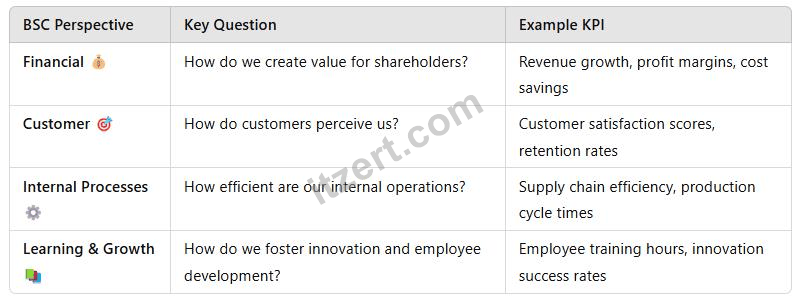
2.2 Application of BSC in Performance Measurement
✅ Holistic View: Measures financial and non-financial performance.
✅ Strategic Alignment: Ensures all departments contribute to business goals.
✅ Data-Driven Decision-Making: Provides insights for process improvements and competitive positioning.
Example:
A logistics company implementing BSC could track:
Financial: Cost per delivery
Customer: Delivery accuracy and satisfaction scores
Internal Processes: Warehouse efficiency
Learning & Growth: Employee training on automation tools
3. Advantages and Limitations of the Balanced Scorecard
✅ Advantages
✔ Aligns performance measurement with business strategy.
✔ Ensures balanced focus across financial and operational areas.
✔ Encourages continuous improvement through KPI tracking.
❌ Limitations
✖ Can be complex and time-consuming to implement.
✖ Needs regular updates to remain relevant.
✖ May require cultural change for adoption across all departments.
Conclusion
Measuring performance is essential for strategic decision-making, operational efficiency, customer satisfaction, financial stability, and continuous improvement. The Balanced Scorecard (BSC) is a powerful tool that provides a comprehensive performance assessment, helping organizations maintain a sustainable competitive advantage.
SIMULATION
Using Porter's 5 Forces, describe the business environment of a company of your choice
Antwort:
Porter's Five Forces Analysis - Business Environment of Tesla
Introduction
Porter's Five Forces Model, developed by Michael Porter, is a strategic framework used to analyze the competitive environment of an industry. It evaluates five key factors that influence a company's profitability and strategic positioning.
For this analysis, we will examine Tesla Inc., a leading electric vehicle (EV) and clean energy company, to assess its business environment using Porter's Five Forces.
1. Competitive Rivalry (High)
The automotive industry is highly competitive, with established brands and new entrants challenging Tesla's market position.
✅ Key Factors:
Traditional automakers (Toyota, BMW, Mercedes, Ford, Volkswagen, GM) are expanding into EVs.
EV-only competitors (Rivian, Lucid, NIO, BYD, Polestar) are gaining market share.
Tesla's technology (battery innovation, autonomous driving) gives it a temporary edge, but competitors are catching up.
Example: Tesla's Supercharger network gives it an advantage, but competitors like Hyundai and Ford are forming EV charging alliances to reduce Tesla's lead.
Impact: Tesla must continue innovation and brand differentiation to maintain market leadership.
2. Threat of New Entrants (Medium)
The barriers to entry in the automotive industry are high due to capital investment, brand recognition, and regulatory requirements.
✅ Key Factors:
High R&D costs for battery technology and autonomous driving deter new entrants.
Tesla's strong brand recognition makes it difficult for new brands to compete.
Government incentives and EV market growth encourage startups like Rivian and Lucid.
Manufacturing expertise required-many new EV companies struggle with scaling production.
Example: Apple planned to enter the EV market but faced challenges in battery sourcing and technology.
Impact: While Tesla faces some risk from new startups, its established brand, patents, and economies of scale help protect its position.
3. Bargaining Power of Suppliers (Low to Medium)
Tesla relies on specialized components and raw materials (e.g., lithium, cobalt, semiconductors) for battery production.
✅ Key Factors:
Tesla has vertically integrated its supply chain, producing in-house batteries (Gigafactories).
Raw material suppliers (e.g., lithium mining companies) hold some bargaining power due to limited global supply.
Semiconductor shortages have impacted Tesla and the auto industry as a whole.
Tesla has long-term contracts with key suppliers, reducing dependency risks.
Example: Tesla sources batteries from Panasonic, CATL, and LG Chem, but it is developing its own battery technology (4680 cells) to reduce reliance on third parties.
Impact: Tesla's vertical integration strategy lowers supplier power, but raw material scarcity remains a challenge.
4. Bargaining Power of Buyers (Medium)
Customers have more choices in the EV market, but Tesla's brand loyalty and product differentiation give it an advantage.
✅ Key Factors:
Consumers compare Tesla against competitors based on price, range, and features.
Tesla's strong brand and innovation (Autopilot, long-range batteries, Supercharger network) reduce customer switching.
As more automakers enter the EV market, customers gain more bargaining power.
Price-sensitive buyers may opt for lower-cost EVs from brands like BYD and Nissan.
Example: Tesla's Model 3 dominates the EV market, but new affordable EVs from Volkswagen and Hyundai give buyers alternatives.
Impact: Tesla must continuously innovate and expand its product range to retain market dominance.
5. Threat of Substitutes (Low to Medium)
Substitutes for Tesla's products include public transportation, hybrid vehicles, and alternative energy solutions.
✅ Key Factors:
Hybrid cars remain an option for customers who are not ready for full EV adoption.
Public transportation and ride-sharing services reduce the need for personal car ownership.
Fuel cell and hydrogen-powered vehicles could emerge as alternatives in the long term.
Example: Toyota is investing in hydrogen fuel cell vehicles (Mirai), presenting an alternative to battery EVs.
Impact: While substitutes exist, Tesla's unique market positioning and growing EV adoption reduce this threat.
Conclusion
Porter's Five Forces analysis shows that Tesla operates in a highly competitive environment, facing challenges from rival EV makers, supplier dependencies, and increasing buyer power. However, its innovation, brand strength, and vertical integration strategy provide a strong competitive advantage.
To sustain growth, Tesla must:
✅ Continue investing in battery technology and AI-driven autonomous driving.
✅ Expand affordable EV options to compete with lower-cost brands.
✅ Strengthen supplier relationships to mitigate raw material shortages.
SIMULATION
Discuss how the following can impact upon supply chain operations and business strategy:
1) Discrimination, equality and diversity
2) Redundancy and dismissal
3) Working time and payment
Antwort:
Impact of Employment Policies on Supply Chain Operations and Business Strategy Introduction Employment policies such as discrimination, equality and diversity, redundancy and dismissal, and working time and payment have a significant impact on supply chain operations and business strategy. These factors influence employee productivity, legal compliance, reputation, and operational efficiency.
For businesses operating in global supply chains, ensuring compliance with employment laws and ethical workforce practices is crucial to maintaining sustainability, cost efficiency, and risk management.
1. Impact of Discrimination, Equality, and Diversity on Supply Chain Operations and Business Strategy Discrimination laws and diversity and inclusion (D&I) policies ensure fair treatment in the workplace.
✅ Impact on Supply Chain Operations
Companies must prevent workplace discrimination across hiring, promotions, and supplier engagement.
Non-compliance with equality laws can lead to legal penalties, reputational damage, and operational disruptions.
Supply chain leaders must promote diverse supplier partnerships and inclusive hiring practices.
Example: Many multinational corporations, such as Unilever and IBM, have supplier diversity programs that prioritize working with minority-owned and women-owned businesses.
✅ Impact on Business Strategy
Encourages innovation and diverse perspectives in problem-solving.
Enhances brand reputation and customer loyalty through ethical business practices.
Helps businesses attract top global talent by fostering an inclusive workplace.
Strategic Action: Businesses should implement anti-discrimination training and diversity recruitment strategies to create a fair and inclusive work environment.
2. Impact of Redundancy and Dismissal on Supply Chain Operations and Business Strategy Redundancy and dismissal policies regulate how companies terminate employment due to economic downturns, automation, or restructuring.
✅ Impact on Supply Chain Operations
Workforce reductions can disrupt production schedules and supplier relationships.
Companies must ensure fair redundancy policies to prevent legal claims or industrial action.
Automation may lead to worker displacement, requiring retraining programs.
Example: Ford's decision to restructure operations in the UK resulted in job losses, requiring compliance with UK redundancy laws and union negotiations.
✅ Impact on Business Strategy
Must balance cost-cutting measures with employee morale and brand reputation.
Need to comply with national and international labor laws to avoid legal action.
Investing in employee retraining and redeployment can reduce negative effects of redundancy.
Strategic Action: Businesses should establish clear redundancy frameworks, provide severance packages, and offer outplacement support for affected employees.
3. Impact of Working Time and Payment on Supply Chain Operations and Business Strategy Working time regulations and fair wage policies impact labor costs, productivity, and compliance.
✅ Impact on Supply Chain Operations
Ensuring compliance with working time laws (e.g., UK Working Time Regulations 1998) prevents overworking employees.
Failure to meet minimum wage and overtime regulations can lead to legal disputes.
Supply chains must ensure fair pay for workers in offshore factories to meet ethical sourcing standards.
Example: The UK National Minimum Wage Act ensures fair wages, while the Modern Slavery Act (2015) prevents exploitation in global supply chains.
✅ Impact on Business Strategy
Fair wages enhance employee motivation and reduce turnover.
Complying with wage and hour laws prevents reputational risks and fines.
Ethical pay practices attract conscious consumers and investors.
Strategic Action: Businesses should conduct regular wage audits and ensure global supplier compliance with fair labor laws.
Conclusion
Employment policies related to discrimination, redundancy, and working time/pay significantly impact supply chain operations and business strategy. Companies must ensure:
✅ Diversity and equality policies to foster innovation and enhance reputation.
✅ Ethical redundancy and dismissal processes to maintain legal compliance.
✅ Fair wages and working hours to improve productivity and worker well-being.
By aligning HR policies with supply chain strategy, businesses can enhance efficiency, reduce risks, and build a sustainable competitive advantage.
Seite 1 von 10 wird angezeigt.
Fragen 1-4 von 40 werden angezeigt.
 1128 Kundenrezensionen


Melchior -
Ich kaufte die Schulungsunterlagen von CIPS L6M2 und habe heute die Prüfung bestanden. Ich will es jedem vorschlagen, der an der Prüfung L6M2 teilnehmen möchte.